When Nintendo stopped talking to its players

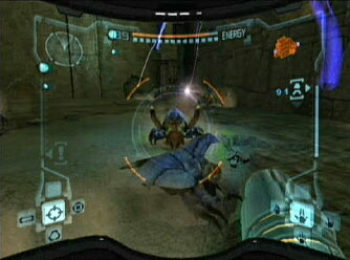
When Metroid Prime was released it was heralded as something of a miracle. So many years after Super Metroid, nobody thought Nintendo would release another instalment. Especially not because Ocarina of Time kind of predicted that Metroid in 3D would not exactly work like Metroid.
So the game, was announced and the fans went nuts as the game seemed to have become a first-person shooter. Was that a problem? To some it was. Regardless of the translation into three dimensions from two, shooter mania was just starting. Microsoft held a genuine classic in the release of Halo, Sony had something stewing called Killzone and Nintendo's own heritage saw GoldenEye and Perfect Dark held in high esteem. There was, in other words, a definite danger in that Metroid's claustrophobic descent into the labyrinthian bowels of an alien planet would be replaced with the pompous grandeur of guns, armies and chokepoints.
Metroid Prime proved the naysayers wrong, it eschewed the first-person shooter tropes and recast players as watching through Samus' helmet, obtaining information through scanning the environment by means of simulated augmented reality and having her abilities recast to make sense within a 3D world. It also helped that one of the previous soundtrack composers was back on board and the opening was a careful recreation of Super Metroid's now legendary Ceres Station scene.
And yet…
When the dust settled, something awful appeared. 2D Game Boy Advance stable-mate Metroid Fusion proved to be the better Metroid-game. Metroid Prime dazzled, won prizes and opened the franchise up to a whole new generation, but it was Fusion that carried the torch and made Prime look almost simplistic and painfully slow in comparison. Something was wrong.
Retro carried on with Metroid Prime II: Echoes and Metroid Prime III: Corruption under the watchful eye of Shigeru Miyamoto himself, and there even was a more first-person shooter oriented instalment called Metroid Prime: Hunters but it was all for naught. The Prime series was a deviation. A reboot if you will. Metroid Zero Mission – a remake of the very first game – was released and with it the 2D-branch of the series died. Its development team was dissolved and that in itself made Nintendo lose a spark of ingenuity. Metroid and the 2D games in particular, was a series made by both the developers and the players. Nothing Nintendo made got even close to it and Zero Mission quietly ended an era.
What was the trouble with Metroid Prime exactly? From the outside it's the perfect translation of the 2D game series into a 3D game environment. Practically all elements from Super Metroid are more or less intact and most are downright copied. There's a display of excellence in both the technology (high frame rate, low loading times and the design (beautiful areas, futuristic sci-fi technology displays), so why, why isn't it really Metroid?
The problem is highlighted through something called lock dashing. Prime has a mechanic wherein the player can lock onto an enemy, simplifying the players movement by replacing move and turn controls with strafing around the enemy. A mechanic borrowed from The Legend of Zelda: Ocarina of Time. In order to create dynamics with locking, players can also press both the jump-button and a direction of the control stick to 'dash' either left or right around the enemy in a short bust of speed. Now when this dash is initiated and the lock is immediately released right after, the player will dash in either direction in a straight line, rather than around the enemy itself. This can be used as kind of makeshift running ability or can be used to cross small gaps.
So far so good, it's exactly this kind of deeper dynamics that older Metroid players crave. But there was something very interesting about lock dashing. It did not just work with enemies. When in scanning mode, the player could lock onto an object to scan it and obtain the same movement effect as when locking upon an enemy. So while the dash was meant to ease combat, it could also be used out of combat to enhance traversal outright.
And it did! With some careful scanning and lock dashing you could reach the coveted Space Jump ability right after touching down on Tallon IV. It broke the game's pace, in what's called a sequence break: playing the game out of the order intended by the game's designers. At this point, the eyes of many a fan lit up. This was what the initial Metroid had started. This was what everybody had been digging through Super Metroid for. This was the start of Metroid Prime becoming a true Metroid game.
So of course Nintendo rushed in to remove it as soon as possible.
Back then, patches for single player console games were unheard of back in those days, so the first US printing of Metroid Prime, retained 'the lock dash bug'. Every other print afterwards removed being able to lock dash while scanning an object. It was kept in for use while locking on an enemy, but it had removed a specific instance of circumstantial dynamics and that flew right into the face of players seeking to restore the conversation between them and the developers.
Nintendo has remained silent ever since.